Every skill you hold is depreciating. Only the rate is different.
The question is no longer which skills matter. It is how fast each one loses its value — and what a person needs in order to keep replacing the ones that expire.
Skills are consumables. Learning rate is the capital.
Orchestration fluency and prompt craft lose value in months, because every interface improvement erodes them directly — the same way search proficiency commanded a premium around 2010 and then quietly disappeared. Domain judgment loses value over years or decades.
The practical rule follows: invest in slowly depreciating assets, even when the fast ones pay a visible premium today. No fixed body of knowledge stays current long enough to carry a career, so the durable asset is not a skill set — it is the capacity to keep acquiring one.
Consequence: a person who bets a career on being good at directing machines is betting on the layer closest to the frontier of automation — the layer most likely to be absorbed by a better interface.
Five capacities, and they only hold in this order.
These transfer across domains. They are listed as a sequence because the later ones do not hold without the earlier ones — a person cannot calibrate what they know while still refusing to be bad at anything.
- Tolerance for incompetence Learning something new means being measurably bad at it. For an adult with professional standing, that contrast with existing competence is the real obstacle. Most people quit here — not from inability, but from the discomfort of not being the one who knows. Observable as: does the person ask the basic question in front of peers
- Calibration Knowing the boundary of your own knowledge, and separating "I understand this" from "I can restate it." The gap between the two is where progress silently stalls, because the person believes they have finished. Observable as: accuracy of self-predicted performance before a task
- Model-based thinking Building an account of why a system behaves as it does, instead of accumulating symptom-response pairs. The person with pairs is helpless on the case they have not seen. Paired with the judgment to skip the model where memorization is simply cheaper. Observable as: asks why, not only which button
- Running your own learning cycle Decomposing the unfamiliar into testable pieces, engineering feedback where none is provided, and staying deliberately in the zone where performance is poor rather than polishing what already works. Observable as: separates those who keep growing from those who plateau at month six
- Structural transfer Recognising that an unfamiliar problem is isomorphic to a familiar one — with the discipline to ask where the analogy breaks, since the same mechanism that produces insight produces confident error. Observable as: names the limit of their own analogy unprompted
What is deliberately not on this list
In critical industries, the floor is what a person will never do.
In manufacturing, energy and data centers, errors are expensive and often irreversible. That inverts the usual logic of a skill baseline: it is defined less by what a person can perform than by what they reliably will not do. Someone highly capable who once energizes a circuit without verifying isolation is a negative value, regardless of everything else they know.
Not knowledge. A set of reflexes and refusals that hold under time pressure, fatigue and instruction from above.
- Procedural discipline — executing a sequence exactly as written, including steps whose purpose is unclear, on the hundredth repetition
- Resistance to normalized deviance — a step skipped a hundred times without consequence is still not optional
- Energy isolation — every stored energy verified to zero, not assumed: electrical, mechanical, pressure, thermal, gravitational, chemical
- Stopping work — the readiness to halt under uncertainty, including when stopping is expensive and a senior says continue
- Honest reporting — recording what happened, not what should have happened; a hidden error costs orders of magnitude more than an admitted one
Enough physical grounding to notice when a number, a drawing or a machine-generated recommendation is not physically possible.
- Order of magnitude — quantitative intuition, not calculation: is this figure even in the right range
- Units and conservation — where the energy goes; in a data center a delivered kilowatt is a kilowatt of heat to remove
- Three physical domains — electrical, thermal-fluid and mechanical, weighted by industry
- Failure behaviour — what degrades, what fails suddenly, and what fails latently and stays invisible until it is needed
- Redundancy that is real — a backup that is never exercised does not exist
- Control versus protection — what the system does on loss of signal, and why suppressed nuisance trips are a standard route to an incident
The slowest part of this work to automate, and the part that carries the highest premium as machine output becomes abundant.
- Symptom, failed component, root cause — replacing a burned part without knowing why it burned is a deferred failure, not a repair
- Test sequencing — ordering checks by cost and by uncertainty removed; effectively a binary search through the system
- Instruments as claims — sensors drift, connections are poor, the wrong thing is being measured; confirm by a second method
- Fault types — steady, intermittent, load- or temperature-dependent; intermittent is the dangerous one, because "it cleared" reads as "it is fixed"
An agent will produce a plausible maintenance recommendation, schematic or calculation. The person is the last checking loop before it reaches equipment.
- Shift handover — undocumented system state is a standard source of incidents at the seam: what was changed, what is temporary, what was not restored
- Observation reported separately from interpretation — "3.2 bar" and "I think it's leaking" are different classes of statement
- Verifying machine output — dimensions, magnitude, physical feasibility, and match to the actual asset configuration rather than the typical one
- Knowing where verification is mandatory — calibrated to the cost of the error, not applied uniformly
Why the same minimum does not apply everywhere
Substitution speed differs by orders of magnitude between these rows, so an industry-wide average is meaningless. Two people with identical job titles can sit in different rows.
The senior tier survives. The ladder to it is being removed.
Verifying competence has historically grown out of producing competence. A person spent years doing routine work, accumulated exposure, and only then began to see errors. Automation takes the bottom rung first. The top rung remains — and the way of manufacturing new people who can stand on it breaks.
The mechanism is not in dispute. The magnitude and the timing are. Reliable data quantifying this effect is not something we have, and we will not present an estimate as though it were measured.
What follows structurally is narrower and more defensible: over the next five to ten years, senior specialists become more valuable while the pipeline that produces them degrades. Whoever learns to build that competence synthetically occupies a very large position.
Three conditions decide learning — and real infrastructure violates all three
Feedback density
Fast and unambiguous signal produces growth. Slow and noisy signal produces years of experience with no accumulated expertise — which is why some trades never develop it.
On live plant: slow, noisy, rareCheap mistakes
Where failure is expensive, people stop attempting — and attempting is the entire mechanism. Learning halts long before ability runs out.
On live plant: mistakes are unaffordableSlack
Learning consumes time and cognitive headroom. A person in permanent overload does not learn anything, whatever their aptitude.
On live plant: none by designThese are not failures of the industry. They are properties of running critical infrastructure correctly. Which is precisely why the learning environment has to be built somewhere else.
Manufacture the environment the job cannot provide.
None of the capacities above are produced by instruction. Every one of them is a function of the environment a person learns in. So the intervention is not a curriculum — it is a place where consequence is real enough to matter and cheap enough to repeat.
Feedback compressed
Years of signal collapsed into minutes. The person finds out immediately whether the diagnosis held, which is the condition under which judgment forms at all.
Restored in simulationFailure as a deliverable
Errors are the product, not the liability. Faults are injected on purpose so that recovering from them is the thing being practised.
Restored in simulationRepetition without exposure
The same critical scenario run twenty times, at no risk to plant, people or uptime — the volume that the live environment can never supply.
Restored in simulationWhat this measures that a test cannot
Every item in the minimum is behavioural. None of it is captured by a knowledge test, which is why existing assessment covers it so poorly.
Measured through behaviour under scenario, not self-report.
- Procedural discipline — will the person skip a step when the clock is running
- Order of magnitude — estimation under time limit, no calculator
- Diagnosis — inject a fault, record the sequence of checks and what was ruled out first
- Verification — plant an error in a machine-generated output and see whether it is caught
- Willingness to stop — a scenario where the correct action conflicts with a senior instruction
- Curiosity — not a test result; a time series of whether the person enters optional branches
The last item is the reason this has to be longitudinal. Curiosity does not resolve in a single session — only as behaviour over time. That record is the asset a one-off assessment cannot produce.
A scenario where the fix creates the next fault.
Operation Compass is a timed decision scenario. The participant works a fault to resolution, and the assessment reads the sequence of decisions rather than a final answer. Everything described in the previous section is a property of the run, not a claim about it.
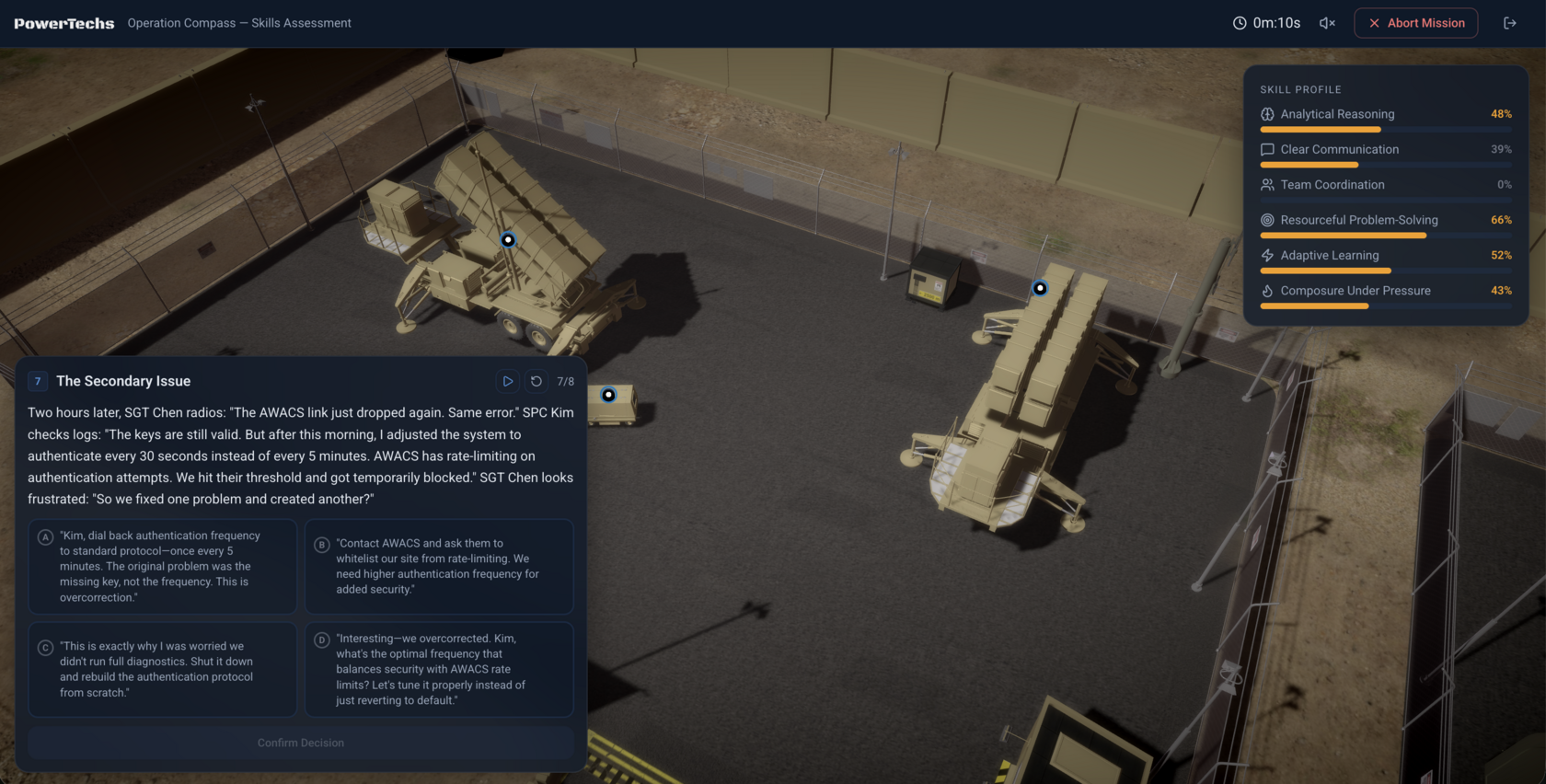
The second fault is self-inflicted
Step 7 does not introduce a new problem. It surfaces the consequence of the participant's own earlier fix — the authentication interval was tightened, and the link now trips a rate limit. Recovering from your own correction is the thing being practised.
Feedback during, not after
The skill profile moves while the scenario runs. That compresses a signal that on a live site would arrive months later, if at all — which is the condition under which judgment forms rather than accumulates as unexamined experience.
Abort and run it again
Aborting costs nothing but the session. The same critical sequence can be run repeatedly at no risk to plant, people or uptime — the volume no live environment can supply.
What separates the four options
Measured now: Level 2 and Level 3. Diagnostic reasoning and the human-and-machine interface both resolve through decisions under time pressure, which is what a branching scenario can observe directly.
Not yet measured: Level 0 and Level 1. Procedural discipline, energy isolation and order-of-magnitude judgment are not readable from a dialogue choice. They need a different task type — executing a procedure step by step with the option to skip, and estimating under a clock without a calculator. Both are on the build path, and we would rather name the boundary than let a scenario stand in for a capability it does not test.