The evidence layer for skills-based hiring.
PowerTechs produces audit-grade proof that a specific person can perform a specific task.


A résumé no longer proves capability.
Any candidate can now generate a resume that mirrors your job description word for word. What is written on the page says less than ever about whether the person can actually do the work. Screening harder does not fix this — it only makes the screen slower.
The only reliable evidence is performance — it identifies contenders versus pretenders. PowerTechs uncovers true skills beyond résumés, making candidates do the work first, then ranking them on what they actually demonstrated. It captures task-level performance and converts it into a verifiable, portable record of what a person can actually do.
Main use case — military-to-civilian transition.
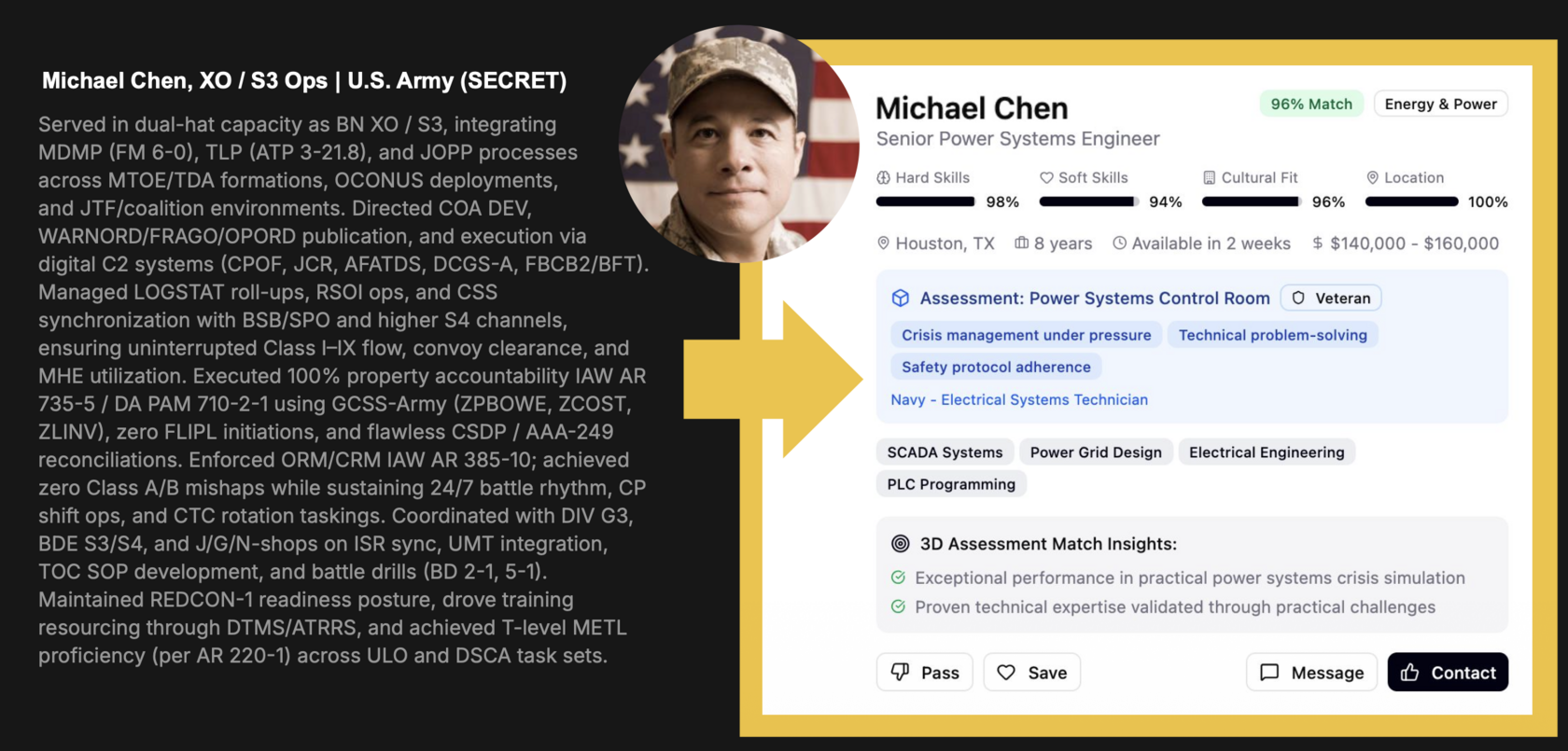
A military résumé loses a lot on the way to a hiring team — the acronyms don't translate, and plenty of what veterans can do never gets written down, because they don't think of it as a skill worth listing.
Two candidates with the same MOS can be years apart in real capability, and neither résumé will tell you which is which.
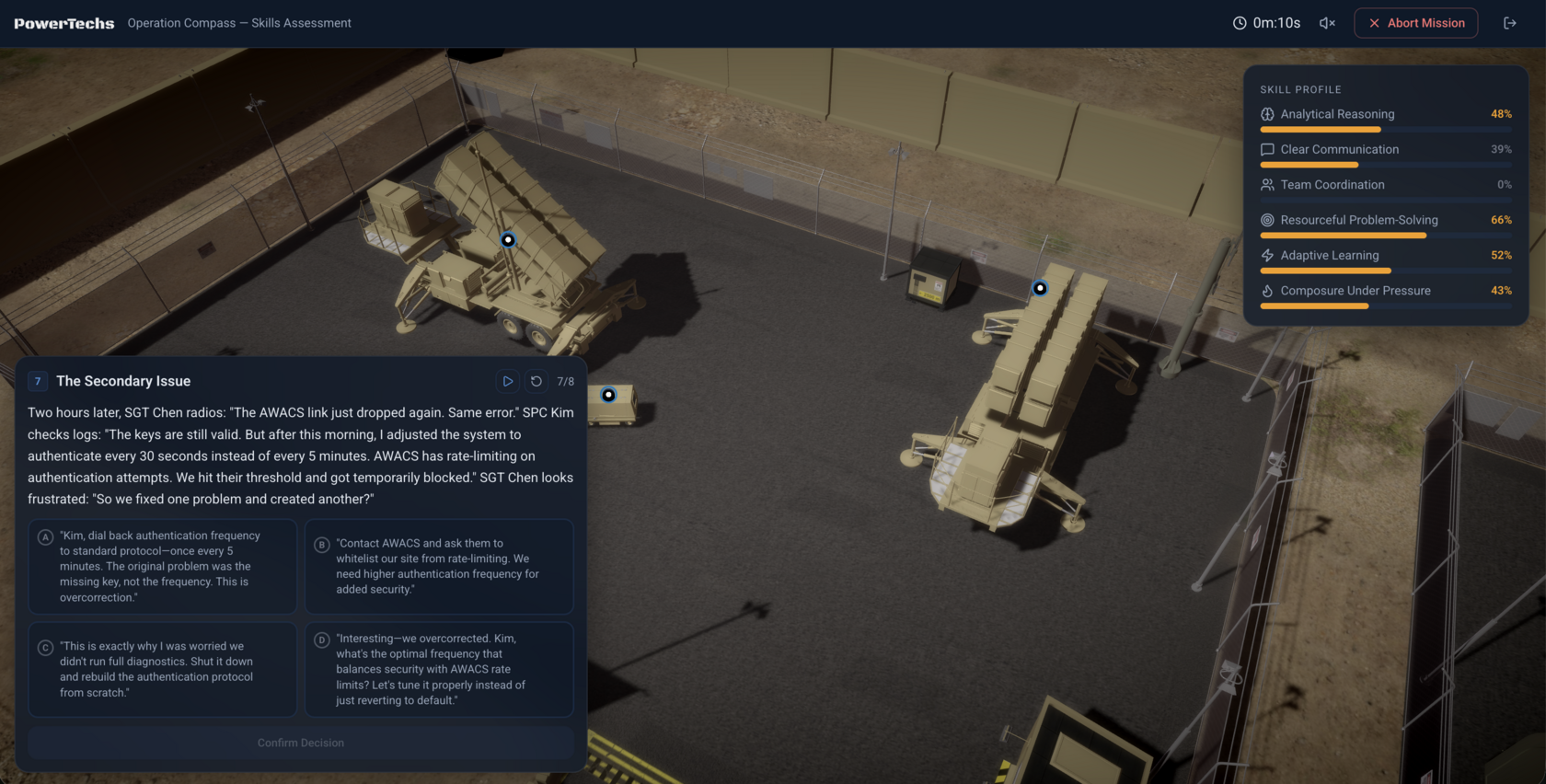
The platform looks like a video game.
The output is a ranked shortlist.
We assess military-connected candidates in a hands-on simulation and return a ranked shortlist mapped to a specific job description — with the evidence behind every ranking.
Demonstrate
A game-like simulation captures task-level performance — not a self-description.
Skill profile
Performance becomes a verifiable profile of what the person can actually do.
Break down the role
We decompose the job description by skill and level so the match holds up.
Ranked shortlist
Candidates ranked against the role, with the evidence attached to each.
A ranked shortlist for one specific req.
Filter by job description, by minimum rating, and by when the candidate separates from service. Open any row to see the evidence behind the ranking — requirement by requirement.
Nothing in the ranking comes from a self-description.
The score is not a personality read or a keyword match. It is built from recorded actions inside the simulation, checked line by line against your req.
Your req, decomposed
We turn the job description into a list of testable requirements and confirm it with your hiring manager before anyone is assessed.
Task-level record
The simulation logs what the candidate did, in what order, how long it took, and where they asked for help.
Requirement ↔ evidence
Each requirement is marked demonstrated, partial, or not shown — tied to the specific task that proves it.
Ranked and defensible
The rating is the weighted result. When a manager asks why someone is at the top, the answer is a record, not an opinion.
Built around the roles you actually hire for.
Simulations are built per role family and tuned to your job descriptions.
Your recruiters read a shortlist, not a stack of documents.
No more decoding
Military job codes, unit names, and duty descriptions are translated into your requirements before the list reaches your team. Nobody spends an evening guessing what an MOS means.
Matching you can defend
Each ranking is tied to demonstrated tasks. When a hiring manager challenges a candidate's place on the list, the answer is a record of what that person did.
Skill-level visibility
You see which specific requirements a candidate has proven and which they have not — so you know before the interview where the training gap sits and how long it is.
A transparent pipeline
Filter by separation date to plan starts around SkillBridge windows, and see the full pool behind the shortlist — including who was screened out and why.
What a résumé you can't verify quietly costs you.
Some candidates look strong on paper and can't do the work. Each one is an interview loop your team still runs and pays for. Move the sliders to your own funnel.
Same 40 minutes — one résumé, or hundreds.
Manual screening scales with recruiter hours. Assessment scales with the candidate's own time — spent in parallel. Same clock, very different throughput.
It's the candidate's time, not yours — and it runs concurrently, so screening capacity stops being capped by recruiter headcount. The 40-minute window that decodes one résumé by hand instead returns a ranked shortlist of hundreds.
A résumé is wrong in both directions — and both are measurable.
Strong on paper, fails the tasks — like the flagged candidate above. Each one is a wasted interview loop your team runs and pays for.
Weak on paper, demonstrates strongly — the veteran who never wrote the skill down. Sitting un-ranked in your ATS today.
Run one live req through PowerTechs.
Pick the role you're struggling to fill.
Book a 30-minute demo and talk it through with us. We'll run one of your open reqs live and put the ranked shortlist next to the résumés your team is seeing today.
Book a demo →Ksenia Solomatina — PowerTechs
ks@powertechs.us
- You send one job description. We map it into measurable requirements and confirm the list with your hiring manager.
- Candidates run the simulation. Military-connected talent works the tasks; performance is recorded task by task.
- You get the shortlist. Ranked, filterable, evidence attached — ready to move straight to interview.