The evidence layer for skills-based hiring.
PowerTechs produces audit-grade proof that a specific person can perform a specific task — at the moment federal dollars and employer offers became contingent on exactly that proof.


A résumé no longer proves capability.
Any candidate can now generate a resume that mirrors your job description word for word. What is written on the page says less than ever about whether the person can actually do the work. Screening harder does not fix this — it only makes the screen slower.
The only reliable evidence is performance — it identifies contenders versus pretenders. PowerTechs uncovers true skills beyond résumés, making candidates do the work first, then ranking them on what they actually demonstrated. It captures task-level performance and converts it into a verifiable, portable record of what a person can actually do.
Main use case — military-to-civilian transition.
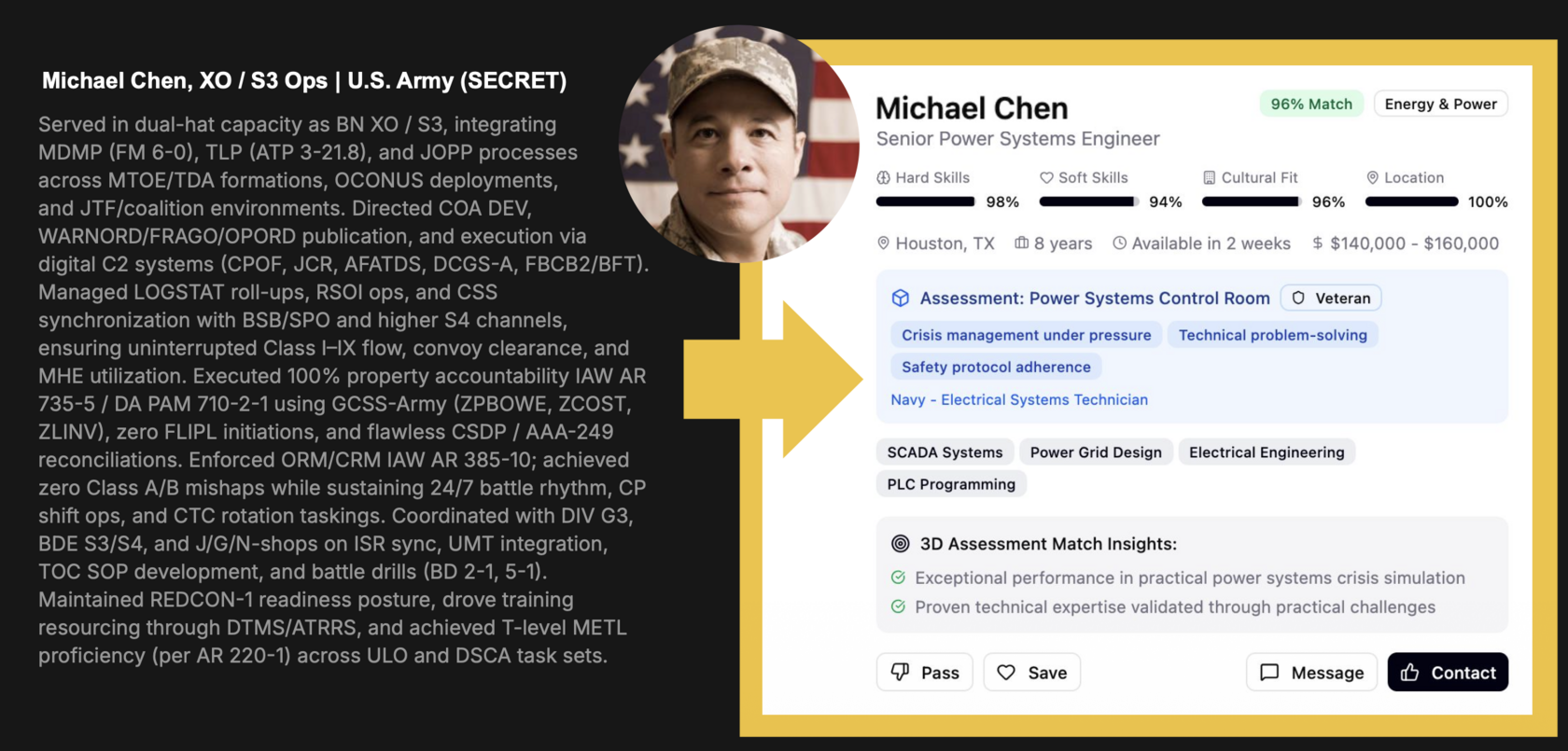
A military résumé loses a lot on the way to a hiring team — the acronyms don't translate, and plenty of what veterans can do never gets written down, because they don't think of it as a skill worth listing.
Two candidates with the same MOS can be years apart in real capability, and neither résumé will tell you which is which.
The platform looks like a video game.
The output is a ranked shortlist.
We assess military-connected candidates in a hands-on simulation and return a ranked shortlist mapped to a specific job description — with the evidence behind every ranking.
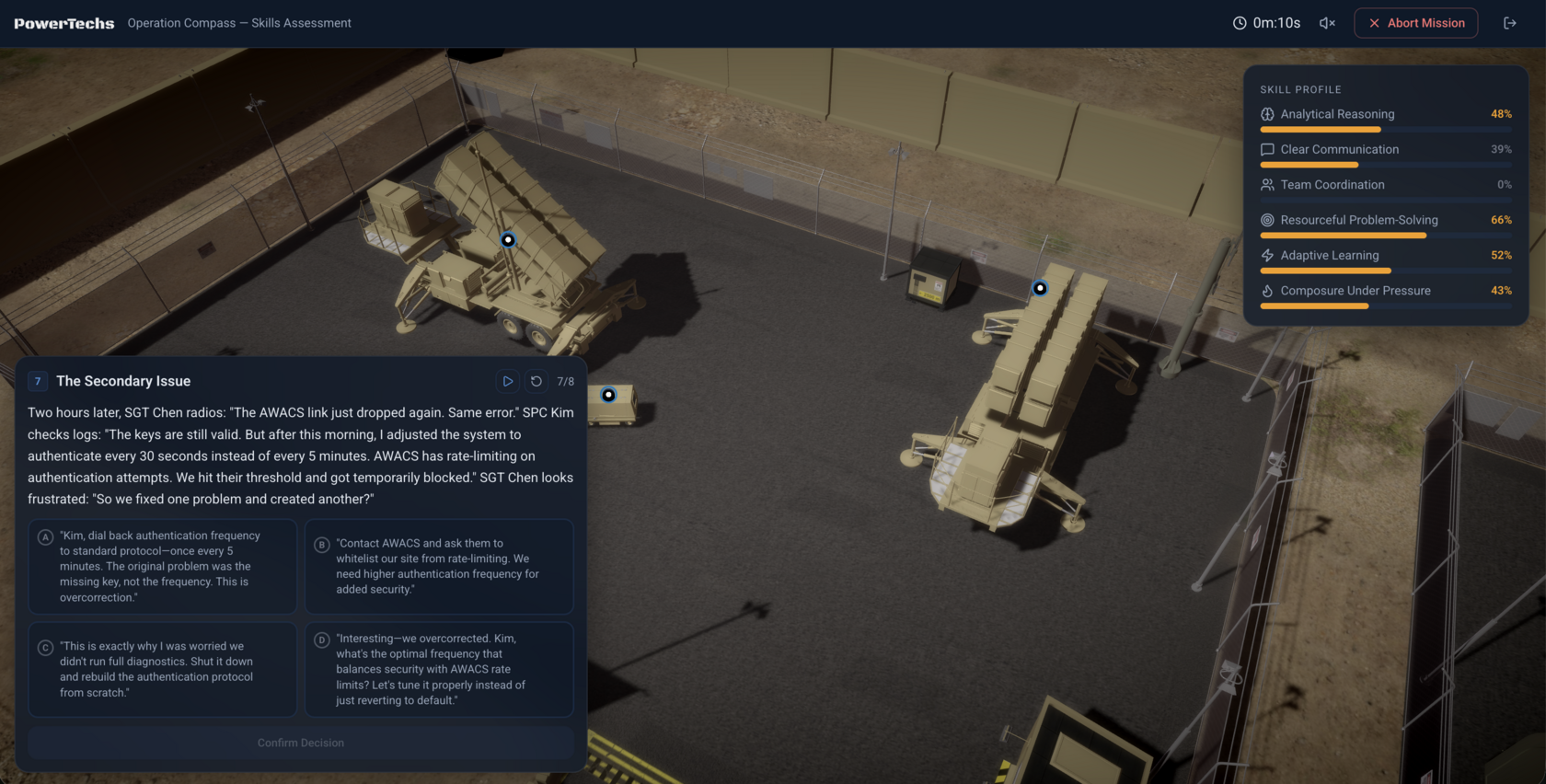
Demonstrate
A game-like simulation captures task-level performance — not a self-description.
Skill profile
Performance becomes a verifiable profile of what the person can actually do.
Break down the role
We decompose the job description by skill and level so the match holds up.
Ranked shortlist
Candidates ranked against the role, with the evidence attached to each.
From pivot to Fort Hood in ten months.
We confirmed that the core problem for these companies is building a military talent pipeline — so that's what we build for them. In the last two weeks alone we've added major names to the pipeline:
Employers pay for a ranked, evidence-backed pipeline — not for résumés.
The candidate side is free. The payer is the employer building the pipeline.
Best in Workforce, AI & cognitive science

- Built & scaled a prior product to 500K+ users
- Sorbonne
- AI in workforce development

- 20+ years VR/AR · Stanford
- e-learning, metaverse & digital humans
- Learning engineering

- 25+ years in innovative talent strategies
- Fortune 500, incl. Panasonic